STEP-SF4.0 – Sugarcane Technology Enabling Project for Sugar Factory 4.0

STEP-SF4.0 and the follow-on STEP-FORE (Sugarcane Technology Enabling Programme – Factory Operational Rejuvenation and Extension) were research and development projects that were public-private partnerships between the South African Government’s Department of Science, Technology and Innovation’s (DSTI) Industry Innovation Partnerships Initiative – Sector Innovation Fund (SIF) programme and the South African sugarcane processing industry. The projects commenced in January 2019 and were completed in September 2024. The projects were overseen by a Steering Committee comprising government and industry representatives and a Technical Review Committee comprising of industry experts.
Background
Historically, the South African sugar industry has attained very high levels of efficiency and process performance, supported by generations of specialist sugar technologists and operational staff who had invested their entire careers in the industry, many of whom have either retired or relocated. Whilst it is acknowledged there are several reasons for the marked decrease in process performance and efficiency that has occurred at least over the last decade, the loss of key skills and knowledge has certainly contributed significantly to this. For example, the loss of pan boiling skills is an often-cited example that has resulted in a decreasing trend in boiling house recovery. There is a great need to capture and embed the knowledge of industry experts and skilled operation staff in interactive operating procedures, decision-support and troubleshooting toolkits and control systems, and improve the performance and competitiveness of the South Africa sugar processing industry.
What were the projects about?
The projects were designed to develop and implement information management systems and decision-support tools aligned with the 4th Industrial Revolution/Industry 4.0 smart manufacturing to enable the sugar processing industry to make meaningful improvements over current factory performance levels. The theme of the projects was to combine sugar technology, data analytics and smart manufacturing principles to drive productivity and efficiency in sugar factories. Sub-projects were constructed to target areas of the sugar factory where significant improvement potential has been identified, and especially where these build on existing tools and projects that have shown promise.
What is Industry 4.0?
Industry 4.0 is a name increasingly applied to initiatives that arise from or lead to increased digitalisation of industries, targeting process improvement, productivity optimisation and automation. These objectives are made possible by recent advances in:
- the speed and quantity at which information can be transferred and analysed,
- improved sophistication of data analytics, facilitating the conversion of vast systems of factory data into information and knowledge for driving real-time data analysis and process decision support, and
- the advent of smart devices and sensors for increasing the volume and detail of data that can be generated in manufacturing processes.
Industry 4.0 projects can range in scope from modules that focus on single unit operations to factory or industry-wide solutions for improving productivity and efficiency. Industry 4.0 applications can involve any, or all, of the nine digital industrial technologies viz. 1) big data analytics, 2) simulation, 3) additive manufacturing, 4) horizontal and vertical data/information integration, 5) industrial internet of things, 6) augmented reality, 7) advanced robotics, 8) cloud computing and cybersecurity.
A significant feature of Industry 4.0 projects is that the software and hardware for each application can be chosen uniquely to suit the needs of the factory and the application. The Development phase utilises MATLAB®, StatisticaTM and Microsoft® Excel. Any other platforms that allow the necessary data aggregation and analysis could be used instead. Similarly, the deployment application could be built in any of several suitable applications. The visualisation step involves development of dashboards and graphical user interfaces that allow factory staff to easily access the knowledge that the Industry 4.0 modules create. This is where the potential of any application is translated into actual benefits. Visualisation can be implemented on existing factory systems or in custom-built applications using software involved in development, deployment¸ or third-party visualisation software.
Staged approach to Sugar Factory 4.0
Figure 1 is a common representation of the stages of Industry 4.0. Industry 4.0 projects may deliver information on the status of a process (stage 1), analysis of why the process has the observed status (stage 2) and predictions on the progression of the process status (stage 3). Stage 4 projects use the combined information from the previous stages to develop automation and control technologies. Each one of these stages has potential to create value opportunities for a particular focus area, through highlighting areas of loss or cost, identifying causes of lost opportunity, providing strategies for reducing lost opportunity, or controlling the process to a higher level of efficiency. The value of benefit will vary between applications and will depend on the efficiency attained before their implementation. As a general rule, the value of the benefit achieved is anticipated to be higher at each successive stage of implementation. Thus, any project that can generate an implementable solution at any one of the four stages is expected to result in cost reduction or increased value recovery.
The STEP-SF4.0 and STEP-FORE projects targeted the first three stages. Automation projects were not planned to be tackled within the programme, but recommendations for potential automation applications were among the outputs of the programme.
Figure 1: Staged approach to industry 4.0 (adapted from https://www.i-scoop.eu/industry-4-0/#Industry_40_design_principles)
The role of the SMRI in Sugar Factory 4.0
While SMRI staff generally lack the operations skills for running factories efficiently, they are uniquely positioned to facilitate the development of Industry 4.0 applications. The key knowledge investment into these applications take place in the development and deployment phases, where the supervisory role is carried out by individuals who have a thorough knowledge of sugar technology, who employ systems thinking, have sound understanding of statistics in analysis of large complex data sets with strong non-linearities and time dependency, have strong process modelling skills, and have sufficient time to investigate different strategies to achieve a defined goal. For example, these skills are employed by the SMRI researchers who worked on the STEP-Bio Energy Monitoring project, which was expanded upon in the STEP-SF4.0 project.
In addition, the SMRI is the custodian of an enormous database of factory performance figures, dating back many decades, and it has strong relationships with all sugar factories in South Africa and their affiliate mills in southern Africa. Also, the SMRI is the primary developer of NIRS prediction equations for the rapid analysis of intermediate sugar factory streams. Offering this as a base technology into the STEP-SF4.0 project enables the almost real-time analysis of fructose, glucose and sucrose of all sugar process streams – a world first – and enables the production of new factory performance data and insights to be gained. The SMRI has a strong track record of collaboration with higher education institutions in South Africa and internationally and has historically leveraged these collaborations to bring new ideas and technologies into the South African sugar industry.
It is acknowledged that, to remain globally competitive, individual factories or sugar companies might be considering implementing Industry 4.0 projects within their own factories using in-house technical support staff and consultants. However, the nature of these projects is somewhat different to traditional sugar technology projects; Pioneer Industry 4.0 projects around the world make use of advanced data analytics skills and software application development. There are few, if any, local or international experts or consultants who have experience integrating these skills with sugar technology. An important objective of the proposed project was to draw on the wisdom of skilled sugar factory and SMRI staff and the capabilities of advances in data analytics to codify sugar technology knowledge into applications that facilitate improvements in factory performance metrics.
Progress of STEP-SF4.0: Pilot projects
A project scoping workshop was held at the SMRI in December 2018 to inform the industry of the project and the concept of Sugar Factory 4.0 and to generate ideas for projects that could be undertaken within the time frame. Four piloting projects were approved as follows and commenced in May 2020.
N-Cent
The overall project aims and expected outcomes are a reduction in the quantity of sucrose lost to final molasses in a sugar factory. The objectives were to: (1) investigate the causes of excessive sucrose losses to final molasses at the C-centrifuge station, using SMRI-NIRS and other technologies, and (2) investigate means of employing data analysis technology to monitor sucrose losses to molasses in real time coupled with an assessment of possible causative factors in the boiling house to provide actionable insights to operational staff. The project proved too complex in its scope to be successfully completed, but valuable lessons were learned for future projects.
D-Ops
The objectives of this project were to:
- Investigate and understand the parameters that directly affect diffuser extraction
- Investigate sensors that can be used for parameters that aren’t currently measured
- Develop a real time proxy for extraction
The solution collected all sources of data on a diffuser and used machine learning to investigate relationships between observed and controllable variables and the diffuser performance in terms of extraction. If the information content of measured variables is enough for the machine learning model to be able to predict diffuser performance, it will be able to identify conditions that have a positive or negative impact on diffuser performance trajectory. Operational problems meant that a limited amount of data could be collected in the 2021 milling season, yet a working dashboard was developed and run at the mill with encouraging results. Further data collection and model development was undertaken in 2022, and although encouraging results were obtained, the host factory decided that the complexity did not warrant the small improvements obtained.
T-Put
The objective of this project was effective management of factory throughput in a sugar factory, with the specific focus areas being:
- Cane and juice throughput
- Brix, pol and non-pol throughput
- Evaporator throughput, considering scale formation
- Pan floor scheduling
- Massecuite throughput through centrifuge
- B- and C-station product recycling
- Tank levels
The consultant considered the factory as a sequence of sub-sections with intermediate flow buffering. A throughput bottleneck is a section which cannot generate output at the rate that the subsequent section can process received input. A model predictive controller (MPC) was built on a MATLAB/Simulink platform and analyses variables correlated with the development of bottlenecks to identify opportunities to pre-empt or mitigate throughput problems. An MPC is a feedback control algorithm that uses a model to predict the future outputs of a process. It then uses a real time optimisation calculation to select appropriate control actions to drive the output to a specified reference value or trajectory. It can be applied to multi input, multi output (MIMO) systems, can handle interactions between inputs and outputs and constraints on control actions.
An open-loop controller was developed and tested on historical data, yielding good results. Following this, it was installed at the factory to take in real-time live data and make control predictions, which were found to be in-line with factory objectives. It was then further developed into a closed-loop model that was able to control certain factory parameters and tested at the factory. Although it was only tested for a short period, it yielded good results, although further development in some areas is required.
STEAM
The overall project aims were a reduction of energy consumption, and the objectives were to monitor:
- High pressure steam distribution and consumption
- Evaporator station exhaust steam consumption
- Aggregated vapour bleed consumption
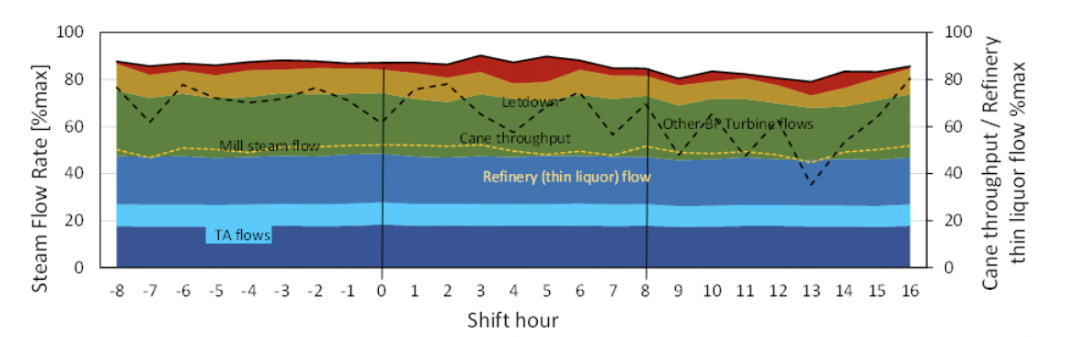
The scope of the project was to replicate the existing SMRI steam supply and vapour bleed consumption monitor in a custom platform and to develop a series of dashboards to allow factory staff to interact with the monitor. This was successfully achieved and implemented live at the factory, gathering and summarising energy data in such a way as to enable factory staff to identify energy usage trends and where excess energy was being used. An example of the energy monitoring dashboard, showing changes in proportions of energy consumed by various processes, is shown below.
Progress of STEP-SF4.0: Development projects
In addition to the pilot phase projects being implemented with the assistance of external consultants, SMRI motivated and received funding for four additional development projects during 2020 and 2021. These projects were largely SMRI-driven, the first three involving the development of instruments and sensors at host factories to provide additional useful data for process monitoring, while the fourth entitled “The feasibility of using NIRS-based chemometric methods for the identification of deteriorated cane” built on an early-stage research project undertaken by the SMRI. Details of the projects are as follows:
Cane preparation sensor
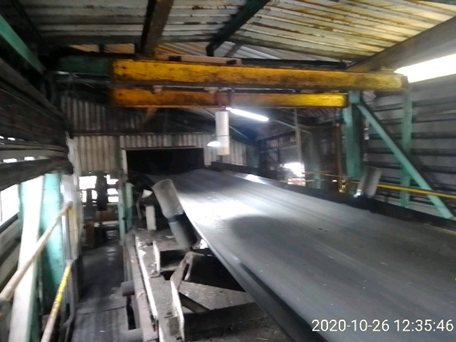
This project aimed to develop a system that predicts characteristics of prepared cane from analysis of images of shredded cane, focusing on cane preparation for diffuser factories. The necessary project equipment was installed in the host factory in October 2020 as shown. Comparison of the rankings by the experts and the image analysis system revealed poor agreement between the image analysis system predictions, the analytical results and the experts’ rankings, and further work would be required to determine if the system could be made to work. It appeared that the range of degrees of preparation of the factory cane was too narrow to enable the image analysis system to be properly trained.
C-Centrifuge camera project
The aim of this project was to develop an image acquisition system that permits centrifuge operators to have a continuous internal view of the centrifuge basket. A camera mounting apparatus with built-in lighting was designed, installed and tested. Some upgrades to the mounting system were required due to the harsh environment. The trial period of the housing allowed assessment of molasses accumulation on the LED light and camera windows and a washing system was manufactured and installed. Images were collected using a strobe and camera, and samples of sugar and molasses were also collected for analysis at the SMRI. However, due to production constraints experienced by the factory there was not sufficient time remaining in the 2021 season to collect sufficient data to complete the project. This project has now continued within the SMRI Research Programme and is making good progress.
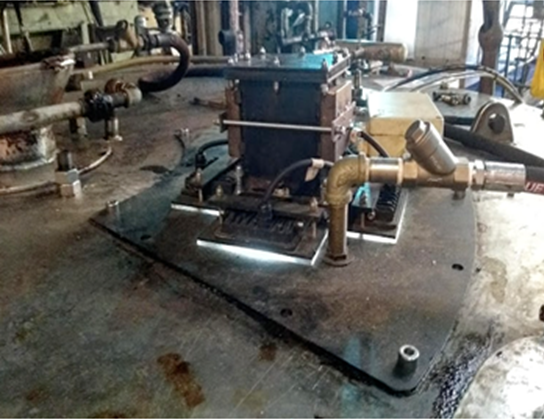
Juice sensing project
The SMRI developed a system that senses the degree of juice saturation within the cane or megasse of a diffuser bed. The initial laboratory tests were successful leading to a second round of testing. Results were sufficiently promising and a factory-scale installation was tested at a South African sugar factory. Very positive test results were achieved, where the levels of juice and cane calculated from sensor inputs corresponded well with visual observations. A method was developed for displaying the information in a meaningful way that can be used by an operator as a decision tool for corrective interventions. A simulator was coded to test the applicability of the display method using a sample of data that was collected at the factory between April and June 2021.
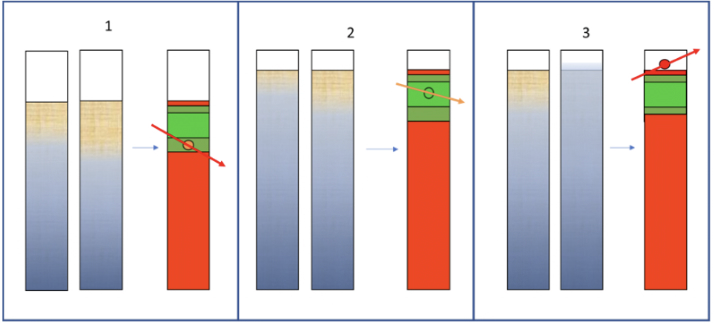
Proposed display technique to show scenarios based on the current juice condition and the condition minutes earlier. 1. Juice level is currently marginally low but will decrease below recommended level. 2. Juice level is currently within acceptable levels but decreasing slightly. 3. Juice is high and increasing to the point of flooding
Cane chemometrics
The feasibility of using NIRS-based chemometric methods for the identification of deteriorated cane. Proof-of-concept was demonstrated in laboratory trials using a laboratory-based air sampling device which required the use of shredded cane. Classification models based on the data obtained from these laboratory trials have been completed. These models were evaluated for their ability to predict deterioration using factory-sourced deteriorated cane. However, shredding of the cane caused the loss of the volatile organic compounds which were produced during deterioration, resulting in the unsuccessful prediction using these classification models. A commercial air sampling device was procured to mitigate the challenges presented by shredding of the cane and allowed the assessment to be made on whole stick or billeted sugarcane stalks. Validation of this commercial air sampler was successfully completed. A field trial was undertaken in January 2022 and discriminant analysis was applied to successfully develop and evaluate classification models for the prediction of deteriorated cane, with classification accuracies of 95.8-100% achieved for the prediction of deteriorated cane in a field trial. The project was completed, but the project steering committee recommended follow-up work, which is now being undertaken via the SMRI Research Programme.
STEP-SF4.0 Workshop
The SMRI arranged and chaired a workshop at the virtual SASTA congress on 19 August 2021 on the STEP-SF4.0 programme. Various speakers from the SMRI and external consultants contributing to STEP-SF4.0 projects presented talks on aspects of the application of 4th Industrial Revolution (4IR) technologies and techniques to the sugar industry as well as highlights from specific STEP-SF4.0 projects being run in the factories. sasta congress 2021 – applying 4ir technologies to address factory performance (sasugar.co.za)
The workshop was attended by 153 delegates from a diversity of organisations. The workshop was well received by the audience and was considered to have been very successful in its objective of raising awareness of the applications and benefits of 4IR technologies to the South and southern African sugarcane processing industries and in particular the projects being undertaken at South African factories by the SMRI and collaborators under the flag of STEP-SF4.0.
Related Journal Articles:
- Sugar Factory 4.0 Project: New opportunities for improved sugar factory performance. C Dardagan, Shukela South Africa, November 2019, pp 15
- Industry 4.0 advancing in local sugar milling. T Hancock, Engineering News South Africa, 6 December 2019