
N-Cent
Host Factory: Illovo Sugar (South Africa) Pty Ltd, Noodsberg Sugar Mill
Consultant: Mzukulu Technologies (Pty) Ltd
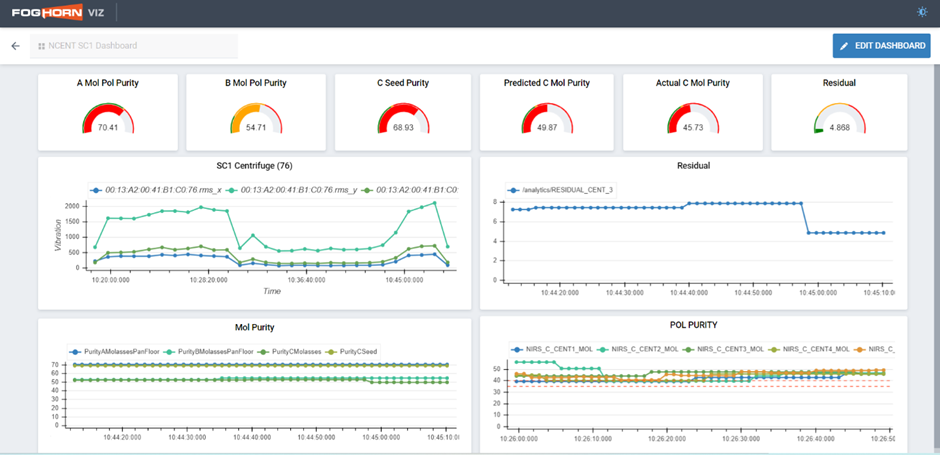
The overall project aims and expected outcomes are a reduction in the quantity of sucrose lost to final molasses in a sugar factory. The objectives are to: (1) investigate the causes of excessive sucrose losses to final molasses at the C-centrifuge station, using SMRI-NIRS and other technologies, and (2) investigate means of employing data analysis technology to monitor sucrose losses to molasses in real time coupled with an assessment of possible causative factors in the boiling house to provide actionable insights to operational staff.
Several delays were experienced with setting up this project, installing hardware and software and collecting required data. However, it is planned to complete the project in 2022 as there is strong support from Noodsberg mill for the outcomes. An example of the dashboard that is being developed is shown below.
D-Ops
Host Factory: RCL Foods Sugar & Milling (Pty) Ltd, Komati Sugar Mill
Consultant: Mzukulu Technologies (Pty) Ltd
Objectives:
- Investigate and understand the parameters that directly affect diffuser extraction
- Investigate sensors that can be used for parameters that aren’t currently measured
- Develop a real time proxy for extraction
The solution collects all sources of data on the diffuser and uses machine learning to investigate relationships between observed and controllable variables and the diffuser performance in terms of extraction. If the information content of measured variables is enough for the machine learning model to be able to predict diffuser performance, it will be able to identify conditions that have a positive or negative impact on diffuser performance trajectory. Operational problems meant that a limited amount of data could be collected in the 2021 milling season, yet a working dashboard was developed and run at the mill with encouraging results. Further data collection and model development is planned for 2022 to deliver the desired outcomes.
T-Put
Host Factory: RCL Foods Sugar & Milling (Pty) Ltd, Komati Sugar Mill
Consultant: Opti-Num (Pty) Ltd
Objective: Effective management of factory throughput in a sugar factory.
Focus areas:
- Cane and juice throughput
- Brix, pol and non-pol throughput
- Evaporator throughput, considering scale formation
- Pan floor scheduling
- Massecuite throughput through centrifuge
- B- and C-station product recycling
- Tank levels
The consultant considered the factory as a sequence of sub-sections with intermediate flow buffering. A throughput bottleneck is a section which cannot generate output at the rate that the subsequent section can process received input. A model predictive controller (MPC) was built on a MATLAB/Simulink platform and analyses variables correlated with the development of bottlenecks to identify opportunities to pre-empt or mitigate throughput problems. An MPC is a feedback control algorithm that uses a model to predict the future outputs of a process. It then uses a real time optimisation calculation to select appropriate control actions to drive the output to a specified reference value or trajectory. It can be applied to multi input, multi output (MIMO) systems, can handle interactions between inputs and outputs and constraints on control actions.
An open-loop controller was developed and tested on historical data, yielding good results. Following this, it was installed at the factory to take in real-time live data and make control predictions, which were found to be in-line with factory objectives. It was then further developed into a closed-loop model that was able to control certain factory parameters and tested at the factory. Although it was only tested for a short period, it yielded good results, although further development in some areas is required. It is planned to continue this project in 2022.
Steam
Host Factory: Gledhow Sugar Company (Pty) Ltd
Consultant: Stone Three Digital (Pty) Ltd
Overall project aims: Reduction of energy consumption
Objectives are to monitor:
- High pressure steam distribution and consumption
- Evaporator station exhaust steam consumption
- Aggregated vapour bleed consumption
The scope of the project was to replicate the existing SMRI steam supply and vapour bleed consumption monitor in a custom platform and to develop a series of dashboards to allow factory staff to interact with the monitor. This was successfully achieved and implemented live at the factory, gathering and summarising energy data in such a way as to enable factory staff to identify energy usage trends and where excess energy was being used. An example of the energy monitoring dashboard, showing changes in proportions of energy consumed by various processes, is shown below.
